
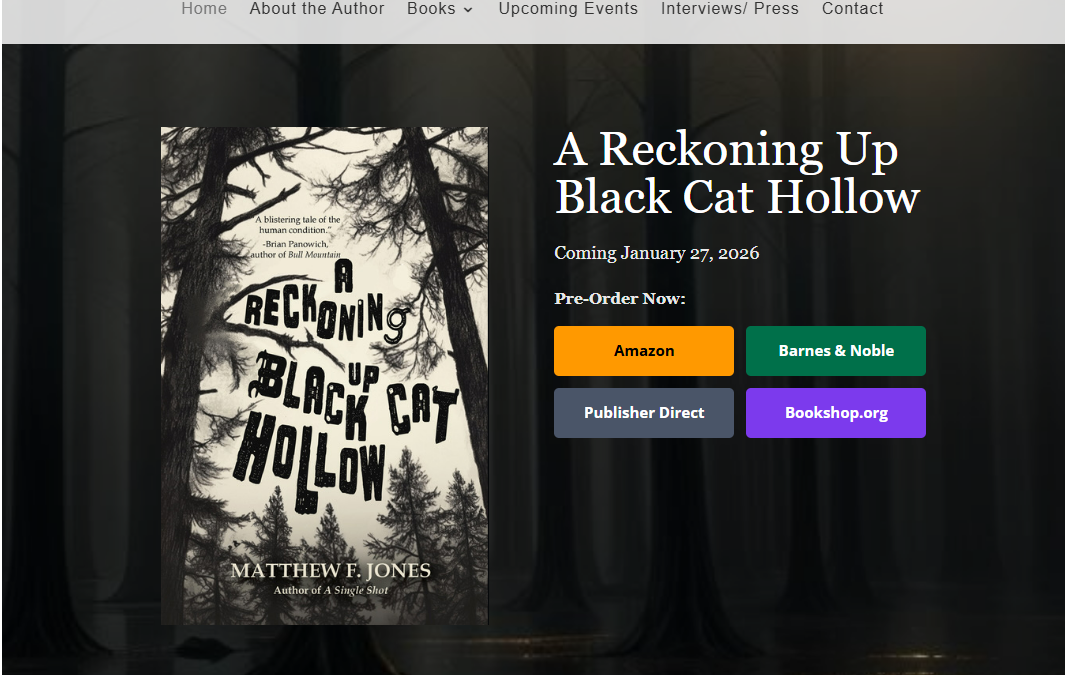
What Working on an Author’s Website Taught Me About a Growing Problem Nobody’s Solving
I’ll be honest with you: I didn’t walk into the redesign work on matthewfjones.com as a seasoned expert in the literary world. I walked in as a web developer with 15 years of WordPress experience, a deep respect for Matthew’s work, and a clear-eyed view of what his site needed technically.
What I didn’t expect was how much that project would teach me — not just about one author’s website, but about a gap that I’ve come to believe affects nearly every author working today, at every level of their career.
Matthew F. Jones is a serious, accomplished novelist. His work has been optioned for film. His books carry real critical weight. His readers are genuinely invested in what he does next. And yet when I started pulling back the layers of his site, what I found was something I now recognize as almost universal: a presence that had been assembled over time, piece by piece, without a coherent strategy behind it. Functional in places. Dated in others. Quietly working against him in ways that weren’t obvious until someone with a technical eye actually went looking.
The Gap Is Real — and It’s Getting Wider
Publishing has changed faster than most authors’ web presence has kept up with.
The rise of self-publishing has put the full weight of discoverability, branding, and audience-building squarely on the author’s shoulders. Platforms like Amazon KDP, IngramSpark, and Substack have lowered the barrier to getting work out into the world — but they’ve done nothing to help writers build the kind of digital infrastructure that turns a casual reader into a longtime fan.
And here’s what surprises people: traditionally published authors face almost the same problem. Publishers still handle distribution and may run campaigns around a launch window, but the expectation that a publicist or publishing house will steward an author’s long-term digital presence is largely gone. Marketing departments are stretched thin. Mid-list authors are left to fend for themselves. Even writers with real momentum often have no one in their corner guiding them on what their website should actually do between book launches.
The result is a large population of serious, talented, working writers with digital presences that quietly undermine everything else they’re building. I don’t say that as someone who has all the answers. I say it as someone who has spent enough time working on these sites to see the pattern clearly.
What the Matthew Jones Project Revealed
Every challenge we worked through on matthewfjones.com pointed toward something larger. I learned as much as I contributed — and a few of the lessons were genuinely humbling in terms of how much low-hanging fruit was just sitting there, costing him readers.
The single biggest win was also the most preventable problem.
When I audited Matthew’s site traffic, the data was stark: roughly 60% of his visitors were arriving on a mobile device. And not a single page on the site was truly readable on mobile. Text was cramped or overflowing. Navigation was awkward. Book pages — the pages that are supposed to convert a curious visitor into an actual reader — were nearly unusable on a phone screen.
Fixing that one issue — making the site properly responsive across devices — led to a 60% improvement in visitor experience metrics almost immediately. Sixty percent of his audience had essentially been bouncing off a wall every time they showed up. That’s not a small problem. That’s the whole ballgame.
It’s the kind of fix that sounds obvious in retrospect, and it is — but only if someone’s actually looking for it. Most authors don’t know to look, and a lot of developers don’t think to check.
Performance was invisible until it wasn’t.
Page speed matters to Google and to readers in equal measure. A site that loads slowly gets quietly deprioritized in search results, and impatient visitors don’t wait around. Cleaning up the performance layer wasn’t glamorous, but it was foundational.
Accessibility had been completely overlooked.
WCAG compliance — the standards that make websites usable for people with visual, motor, or cognitive disabilities — is something almost no author websites address. It matters ethically, and it matters practically: accessible sites are better structured, better indexed, and more professional. It’s detailed, unglamorous work, but it’s the kind of thing that separates a site that merely exists from one that actually performs.
The book purchase experience had friction nobody had noticed.
Getting a reader from “I’m interested” to “I bought the book” is the whole game — and the path was full of small obstacles. Buttons in the wrong places, links that didn’t track correctly, a layout that buried the call to action on smaller screens. None of it was intentional. All of it was fixable.
There was no architecture for what comes next.
A site built around one book with no plan for the next is a site that will need to be torn down and rebuilt every few years. Building with the long view takes someone who understands both the technical structure of WordPress and the actual shape of an author’s career — and those two things don’t often live in the same person.
What Every Author Website Actually Needs to Do
Whether you’re self-published, traditionally published, or still figuring out which path is yours, your website has a specific job. It’s not a digital business card. It’s your anchor — the one place on the internet you actually own, that isn’t subject to an algorithm change or a platform’s shifting priorities.
Done right, an author website should:
Establish immediate credibility.
A reader who picks up your book and Googles your name should land somewhere that deepens their interest. A journalist should find a clean bio in under thirty seconds. First impressions are fast and they’re permanent.
Drive book discovery and sales.
Every page is an opportunity to put your work in front of someone who didn’t know it existed. Clean calls to action, smart internal linking, and SEO-optimized book pages turn passive traffic into real readers.
Tell readers where to find you.
Events, readings, signings, podcast appearances, workshops — if you’re out in the world doing the work of being an author, your website should be the living record of that. It signals activity and gives people a reason to come back.
Grow your list.
Your email list is the only audience you truly own. A well-placed opt-in and a newsletter worth subscribing to turn one-time readers into the kind of fans who pre-order your next book.
Work on every device, for every reader.
The Matthew Jones project made this crystal clear. If you don’t know what your site looks like on a phone right now — go check. Today. The majority of your readers are already there.
The Real Problem Isn’t the Technology
Most authors don’t have a bad website because they don’t care. They have a bad website because no one ever helped them understand what a good one should do — and most web developers don’t understand enough about an author’s world to ask the right questions.
I won’t pretend I have one foot firmly planted in the literary world. I’m newer to those circles, still building those relationships, still learning. What I do have is genuine curiosity about the work writers do, a growing familiarity with the specific pressures authors face in the current publishing landscape, and the technical expertise to actually fix the problems I find.
I’m also a writer myself — working on my own long-form project — which means I understand in a personal way what it feels like to pour yourself into something and want the world it lives in to reflect that effort. That shapes how I approach this work in ways that are hard to quantify but easy to feel in the conversation.
The gap I keep running into — between technical execution and a real understanding of the author’s world — is one I’m genuinely motivated to close. Not because I have it all figured out, but because the problem is real, the need is clear, and the work is worth doing.
If Any of This Sounds Familiar
If you’re an author and your website has been quietly nagging at you — if you’ve suspected it could be doing more, or you’re not even sure what it’s doing at all — I’d love to have a conversation. Not a pitch. Just a conversation.
Start with this: pull up your site on your phone right now. If what you see gives you pause, that’s probably where we begin.